The Ebook You Actually Keep: A Reader’s Guide to Buying, Owning, and Reading Digital Books on Ebokio
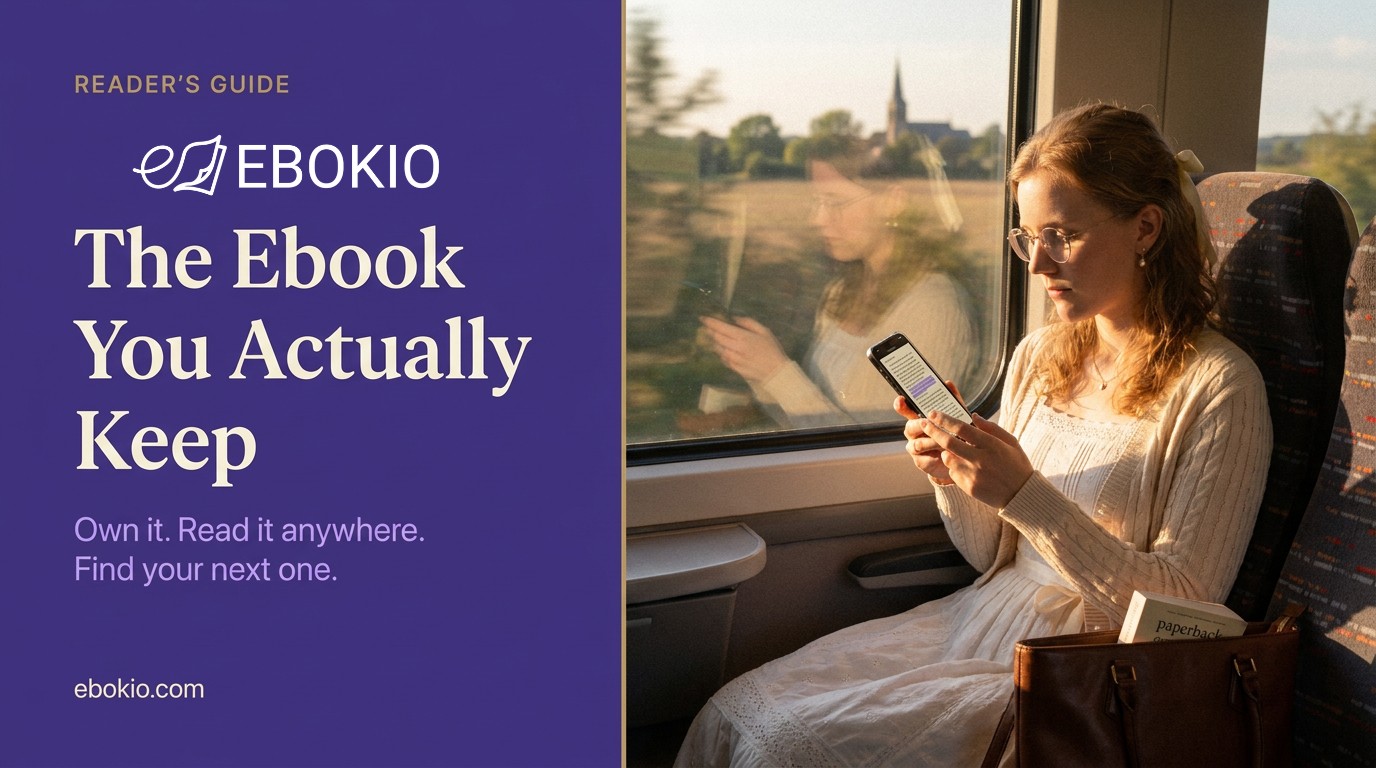
What do you really get when you buy an ebook? Learn about DRM, licences, screen reading, and how Ebokio’s DRM-free browser reader keeps your books yours.
Few readers open the terms of service before they buy an ebook. Most of the time, nobody needs to. The fine print only becomes interesting on the day a purchased book refuses to open, or a backup option you counted on vanishes from your account. From that moment, the terms are the whole story.
This guide is written for people who read. It is not for publishers or analysts. It is for anyone deciding where their next hundred books will live. You will learn what an ebook is beneath its cover, what you receive when you pay for one, how reading on a screen affects understanding, and which tools turn a plain file into a reading experience worth returning to. The working example throughout is Ebokio, a store built around exactly these questions.
What an Ebook Is, Beneath the Cover
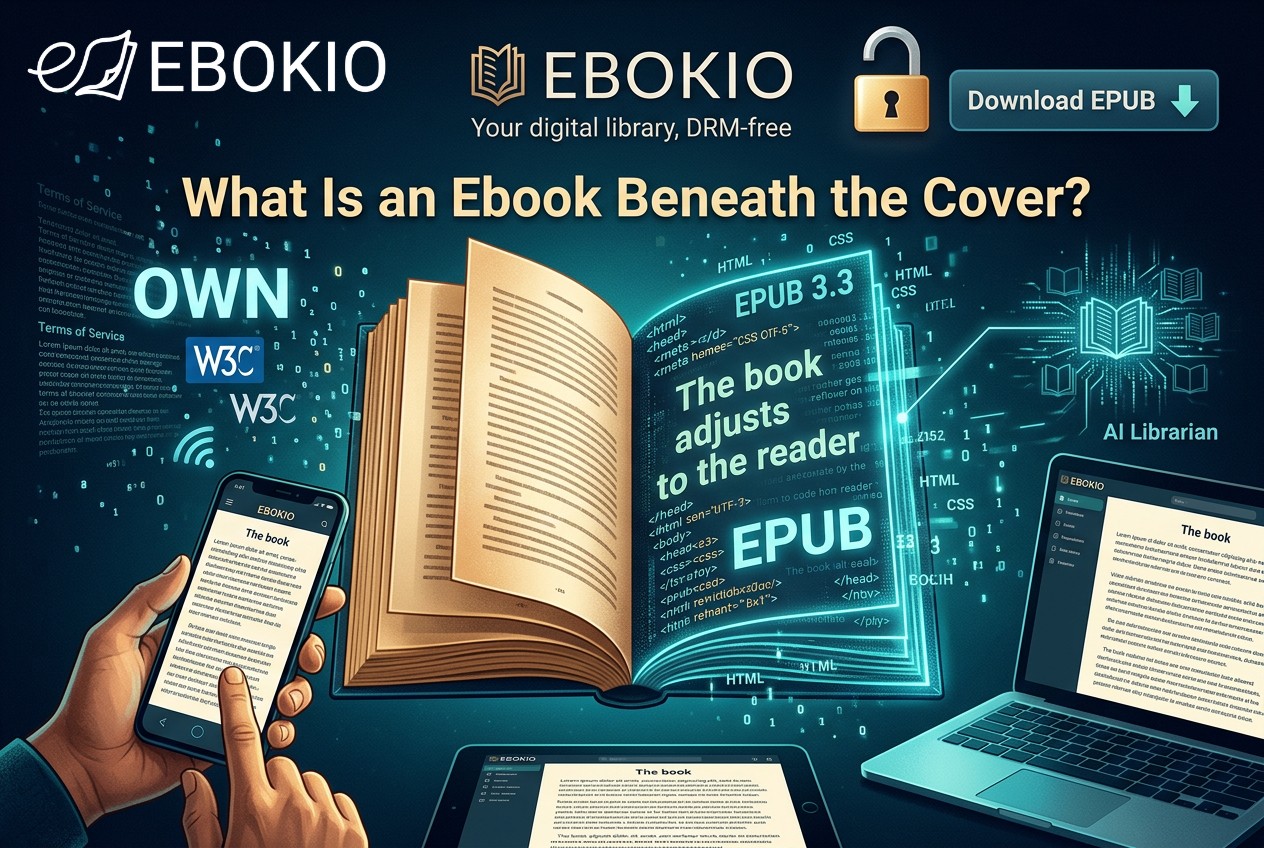
An ebook is a book packaged as a digital file. The dominant format is EPUB, an open standard now maintained by the World Wide Web Consortium. Its current version, EPUB 3.3, became a W3C Recommendation in 2023. Inside an EPUB sits the same material as a web page: HTML for the words, CSS for the styling, images, and a navigation file that powers the table of contents.
That structure explains the real difference between an ebook and a PDF. A PDF pins every line to a fixed page. An EPUB is reflowable, which means the text rearranges itself around your screen, your chosen font size, and your preferred margins. On a phone, lines shorten. On a laptop, they stretch. The book adjusts to the reader, not the other way round.
Accessibility now belongs to the format itself. The EPUB Accessibility 1.1 specification became part of the standard and was aligned with the European Accessibility Act, whose rules have covered ebooks and reading software sold in the EU since 28 June 2025. For a reader with low vision or dyslexia, a properly built ebook is no longer a courtesy. It is the minimum.
What Is Ebokio?
Ebokio is an AI-powered ebook store and digital library operated by Ebokio Ltd, a company registered in England and Wales. It joins three services that readers usually juggle separately: a bookshop, a reading app, and a recommendation engine.
• The store. Books span mystery and suspense, romance, science fiction and fantasy, horror, and more. Each title has its own page listing the author, format, language, and price.
• The reader. The Ebokio reader opens every book straight in a web browser, on a phone, tablet, or computer.
• The recommendation engine. The AI Librarian lets you describe the book you are after in everyday language, then pulls matching titles from the live catalogue.
The whole site runs in English, German, and French. There is nothing to install, and the books carry no DRM. That last detail deserves a section of its own.
Buying or Borrowing? The Licence Question Most Readers Skip
Press “buy” in most ebook stores and you receive a licence to read the book on the store’s conditions. You do not receive a copy you control. On an ordinary day, the difference is invisible.
California put that gap into law. Its statute AB 2426, in force since 1 January 2025, requires sellers of digital goods, ebooks included, to state plainly when a “purchase” is only a licence. The law exempts goods that buyers can download and keep offline for good. In other words, lawmakers drew the line between owning and renting at the download button.
The lock that keeps a licence revocable is DRM, short for digital rights management. DRM encrypts the file so that it opens only inside approved apps or devices. When the store rewrites its rules, your library is rewritten with it.
Kindle owners felt this in 2025. On 26 February, Amazon withdrew the “Download & Transfer via USB” option that had let customers save purchased books to a computer. Books still reach Kindle devices over Wi-Fi, yet a personal backup outside Amazon’s system is no longer on offer.
Ebokio goes the other way. Its books are DRM-free, and every buyer receives a downloadable file alongside the browser edition. You can read in Ebokio’s own reader, store a copy in your personal archive, or open it in another reading app that supports the format. The book follows you. You are not tied to the platform.
One Reader, Every Screen, Zero Installation
Most ebook ecosystems bind your library to their own software. Apple Books, for example, has no Android or Windows app, so leaving Apple hardware means leaving those books behind as well.
Ebokio’s reader lives in the browser. Open a novel on your work laptop at lunch, continue on your phone during the commute, and finish on a tablet at home. Progress syncs through the cloud, so the page you left is the page you find. There are no updates to install, no storage to free up, and any borrowed device becomes a reading device the moment you sign in.
The page itself bends to your habits:
• Reading themes, including sepia, night mode, and a custom palette you build yourself.
• Full control of typeface, text size, margins, and line height.
• Page turns with a tap at the screen edge, or continuous scroll for readers who prefer it.
• Ambient soundscapes for anyone who concentrates better with gentle background noise.
Does Reading on a Screen Change How Much You Understand?
Readers ask this more than any other question about ebooks, and the research is clearer than many articles suggest.
A 2018 meta-analysis led by Pablo Delgado, covering studies published between 2000 and 2017, found that readers understood texts slightly better on paper than on screens. Two conditions widened that gap: informational texts and reading against the clock. The authors tied the effect to shallower engagement. On screens, people skim more and rate their own understanding too generously.
Fiction tells another story. A 2022 meta-analysis by Annika Schwabe and colleagues, restricted to narrative texts, found no reliable disadvantage for reading novels and short stories on a screen. If your reading is mostly fiction, the medium is not the obstacle.
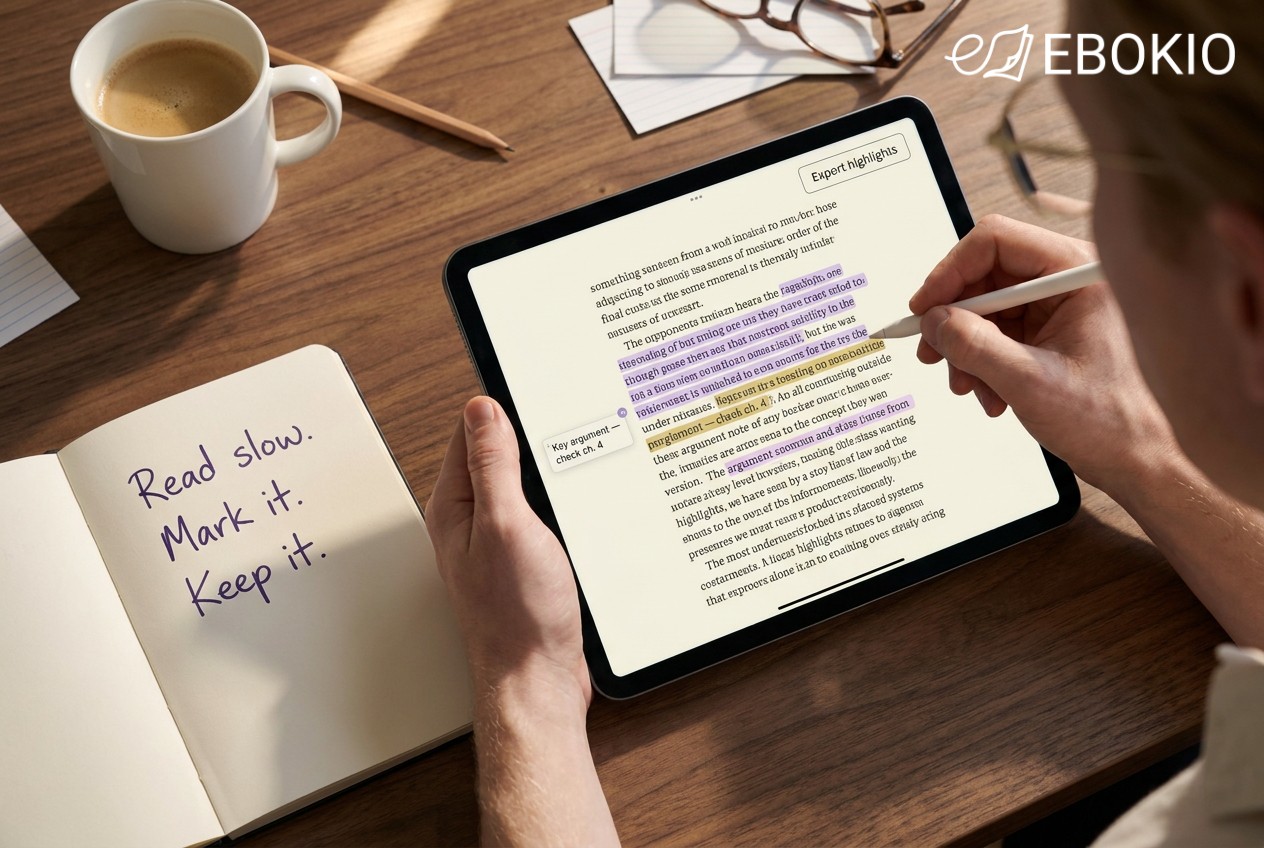
For nonfiction, the remedy is behaviour rather than paper: slow down, mark the text, and write about what you read. Ebokio’s reader is designed for that kind of active reading.
• Multi-colour highlights, so you can separate definitions from arguments, or quotations from open questions.
• Margin notes pinned to the exact passage that prompted them.
• Freehand drawing over the page, for arrows, circles, and quick sketches.
• Export of every highlight and note into a clean document you can study, cite, or share.
The export feature closes the loop the research describes. You stop skimming because you are collecting. Later, rereading your notes away from the book becomes a quiet test of what you retained.
Following a Crowded Plot: Story Map Compared With Kindle X-Ray
Long novels share a weak spot. Chapter twelve mentions a minor character from chapter two, and you cannot place her. With a paperback you flip back and scan. In an ebook, that search is harder, because you have no physical memory of where the earlier scene sat in the volume.
Amazon’s answer is X-Ray, a Kindle feature that lists the people, places, and terms in supported books, with links to every mention. It works well as a reference index. An index, though, tells you where a name appears, not why it matters.
Ebokio’s Story Map follows characters, places, and turning points as the plot develops. Instead of an alphabetical list, you see the shape of the book: who carries weight, where events unfold, and which moments shifted the direction of the story. In a sprawling fantasy saga or a thriller told from five viewpoints, that shape is the first thing a reader loses and the thing they most need back.
Asking the Book a Question, With the Page as Proof
AI reading assistants reached mainstream ebook apps in late 2025. Amazon introduced Ask this Book in December 2025, launching it in the Kindle iOS app for US readers and English-language titles, with other devices promised later. It gives spoiler-free answers about characters and plot.
Ebokio’s Ask AI sits inside the browser reader, so it is not tied to one operating system or one app store. Two design choices give it the edge:
• Every answer cites the text. You can jump to the quoted passage and check the claim yourself, rather than trusting an unsourced summary.
• It never reaches past your bookmark. Ask about a suspicious character in chapter nine and you will not learn what happens in chapter twenty.
Citations matter more than they first appear to. An assistant that paraphrases a novel can be wrong with total confidence. An assistant that points to the page lets the author have the final word. This question-and-answer tool, branded Ask This Book, belongs to Ebokio Plus, the premium AI layer, alongside smart summaries and side-by-side book comparisons for eligible titles you own.
Listening, Translating, and Looking Things Up
Some reading time arrives while your eyes are busy elsewhere: cooking, driving, walking the dog. The Ebokio reader can read any passage aloud in a natural voice, and Ebokio Plus adds AI text-to-speech on supported titles. You move from reading to listening without leaving the book or paying again for an audiobook.
Other tools wait a tap away:
• Define an unfamiliar word without opening a dictionary.
• Translate a word or phrase, handy for readers tackling one of the German-language novels in the catalogue.
• Search the web for a place, a historical figure, or a reference the author assumes you know.
• Bookmark any spot you plan to revisit.
Finding Your Next Book Without Endless Scrolling
Most stores recommend books based on what other shoppers bought. That method rewards bestsellers and buries almost everything else.
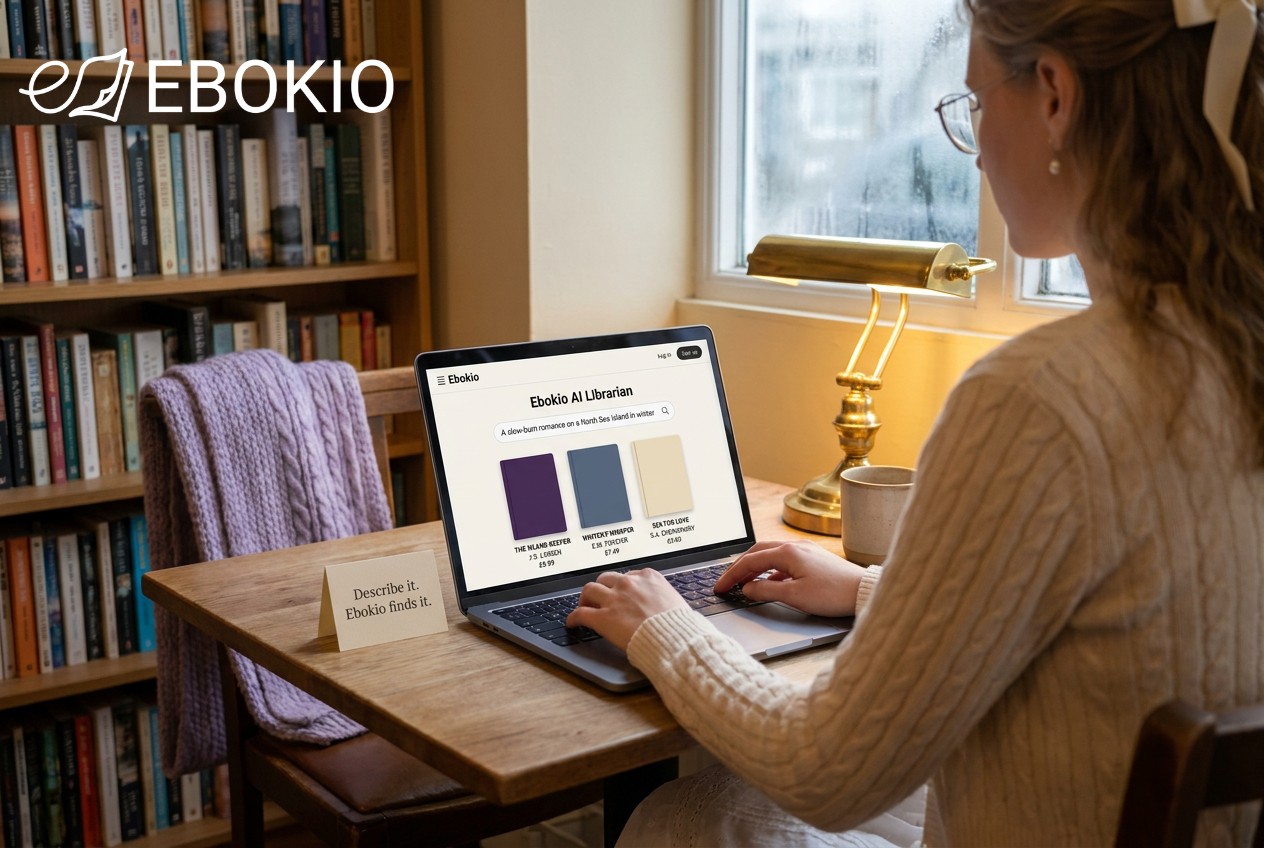
Ebokio’s AI Librarian begins with your wish rather than the crowd’s history. You describe it in your own words, in English, French, or German: a slow-burn romance on a North Sea island in winter, a short horror novel for a single evening, a mystery with a narrator you cannot trust. The Librarian compares the request with each book’s description, metadata, and content, then returns titles from the live catalogue that match. You can steer it toward free ebooks, budget deals, or premium titles with advanced reading features.
Traditional browsing still has its pleasures. Wander through all categories, check new releases, or open an author page and read through a backlist. Before you pay, a free sample of roughly 10% of the book lets you judge the voice for yourself.
A Curated Shelf, and the Writers Behind It
Open self-publishing platforms often fill up with rushed uploads. Ebokio adds a human checkpoint: a real person reviews each title for formatting, metadata, and content rules before it goes on sale. Readers get a shelf with a quality floor.
Much of the catalogue comes from independent authors who publish through Ebokio Publishing. For readers, that brings two rewards. You meet voices that never make it onto airport bestseller tables. And the connection with a writer continues past the last page: verified buyers can leave reviews, follow an author, and receive a notification when the next book goes live.
Where your money lands matters too. Authors on Ebokio keep 70%, 80%, or 90% of net receipts, depending on their plan, as set out on the publishing pricing page. A larger share of every sale reaches the person who wrote the book. Checkout accepts cards, Apple Pay, and Link, with prices shown in multiple currencies. If you write as well as read, the publishing guides explain how to put your own manuscript on the same shelves.
Five Questions to Ask Before You Buy Any Ebook
Whatever store you choose, these five checks protect your library over the long run:
1. Is the file DRM-free, or locked to one app? On Ebokio, every book is DRM-free.
2. Can I download a copy and keep it outside the store? Ebokio includes a downloadable file with each purchase.
3. Will it open on any device I own, including one I buy next year? Ebokio needs only a web browser.
4. Can I take my highlights and notes with me? Ebokio exports them to a clean document.
5. Can I sample the book before paying? Ebokio offers a free preview of about 10%.
A store that answers “no” to the first two questions is lending you a book on its own terms. That may be acceptable for a light holiday read. For the books you plan to reread, quote, and hand down, the answers carry weight.
The simplest way to test all five is to try them. Browse the Ebokio catalogue, describe your next read to the AI Librarian, or tour the reader’s tools on the feature page. Then open a sample, highlight a line you like, and see how it feels to read a book that stays yours.
Notes
• DRM-free does not mean copyright-free. The author keeps the rights, and your copy is for personal use. Please do not share files publicly.
• Ask This Book, smart summaries, side-by-side comparisons, and AI text-to-speech belong to Ebokio Plus and apply to eligible titles. Availability can vary from book to book.
• Details about Kindle features reflect public reporting at the time of writing (October 2026). Check Amazon’s own pages for current availability in your region.
• Research on screen and paper reading reports average effects across many readers. Your own habits, the type of text, and the device all shape the outcome.
• California’s AB 2426 applies to sales in California. Consumer rules on digital goods differ between countries.
Frequently Asked Questions
What is an ebook?
An ebook is a book distributed as a digital file. The most common format, EPUB, is built from web technologies, so text reflows to fit any screen and lets you adjust fonts, sizes, and margins.
Do I keep the ebooks I buy on Ebokio?
Yes. Ebokio books are DRM-free, and each purchase includes a downloadable file in addition to the browser edition. You can archive it and open it in other compatible reading apps. Copyright still belongs to the author, so the file is for your personal use.
Do I need an app or an e-reader to read on Ebokio?
No. Every book opens directly in a web browser on a phone, tablet, or computer, and your reading progress syncs between devices.
Is reading an ebook worse for comprehension than reading print?
For fiction, meta-analyses find no reliable difference. For informational texts, especially under time pressure, paper holds a small edge. Active reading with highlights, notes, and exported summaries narrows that gap.
How does Ebokio’s Story Map differ from Kindle X-Ray?
X-Ray works as an index of people, places, and terms with links to each mention. Story Map follows characters, places, and turning points as the plot unfolds, so you see how the story is built rather than only where names appear.
What does the AI Librarian do?
It turns a plain-language description, written in English, French, or German, into a list of matching books from the live Ebokio catalogue, including free, budget, and premium titles.
What is Ebokio Plus?
Ebokio Plus is the premium AI layer of the platform. It adds Ask This Book for eligible owned titles, smart summaries, side-by-side comparisons, and AI text-to-speech where supported.
Are there free ebooks on Ebokio?
Yes. The free shelf includes independent releases and limited-time promotions, and every paid book offers a free sample of about 10% before you buy.
Which languages does Ebokio support?
The site, the help centre, and the AI Librarian work in English, German, and French, and the catalogue includes English and German titles.
Sources
1. Ebokio, “AI Ebook Store & Digital Library”: https://ebokio.com/
2. Ebokio, “The Ebokio Reader — Features in Motion”: https://ebokio.com/reader
3. Ebokio, “Ebokio Plus: AI Reading Tools and Ask This Book”: https://ebokio.com/ebokio-plus
4. Ebokio, “AI Librarian”: https://ebokio.com/ai-librarian
5. Ebokio, “Help Center for Readers”: https://ebokio.com/help/store
6. Ebokio Publishing, home page, FAQ and royalties: https://publishing.ebokio.com/
7. Ebokio Publishing, “Pricing”: https://publishing.ebokio.com/pricing
8. W3C, “EPUB 3.3 becomes a W3C Recommendation” (2023): https://www.w3.org/news/2023/epub-3-3-becomes-a-w3c-recommendation/
9. EUR-Lex, Directive (EU) 2019/882, the European Accessibility Act: https://eur-lex.europa.eu/eli/dir/2019/882/oj
10. Greenberg Traurig, “AB 2426: New California Law Requires Clear Licensing Disclosures for Digital Goods” (December 2024): https://www.gtlaw.com/en/insights/2024/12/ab-2426-new-california-law-requires-clear-licensing-disclosures-for-digital-goods
11. The Verge, “Amazon will stop allowing Kindle book downloads to your PC soon” (February 2025): https://www.theverge.com/news/612898/amazon-removing-kindle-book-download-transfer-usb
12. Digital Trends, “Kindle’s new Ask this Book feature lets readers get answers without leaving the page” (December 2025): https://www.digitaltrends.com/phones/kindles-new-ask-this-book-feature-lets-readers-get-answers-without-leaving-the-page/
13. Delgado, P., Vargas, C., Ackerman, R., & Salmerón, L. (2018). Don’t throw away your printed books: A meta-analysis on the effects of reading media on reading comprehension. Educational Research Review, 25, 23–38: https://doi.org/10.1016/j.edurev.2018.09.003
14. Schwabe, A., Lind, F., Kosch, L., & Boomgaarden, H. G. (2022). No negative effects of reading on screen on comprehension of narrative texts compared to print: A meta-analysis. Media Psychology, 25(6).
Related articles
- What Is an Ebook? The File, the Licence and the Room You Read In – What is an ebook? Learn how formats, DRM and reader tools shape what you buy, and how Ebokio’s DRM-free EPUBs, Story Map and Ask AI improve every read.
- The eReader for People Who Gave Up on eBooks – Hate eReaders? The problem is usually the store, the DRM, or the price — not the screen. Five objections tested, and the reader that answers them without...
- Ebooks in 2027: The Trends Quietly Rewriting How We Buy, Read, and Own Digital Books – Discover the five forces defining the ebook market in 2027 — AI discovery, AI narration, and the return of ownership — and why Ebokio's AI ebook store is...
- The Best Way to Read Ebooks on a Tablet in 2027: Set Up the Glass, the Page and the Habit – Make your tablet read like a book in 2027: matte screens, smart lighting, line length, stylus notes and spoiler-safe AI help, step by step with Ebokio.
Ebooks to explore
- The First Moira by Desislava Vasileva
- The Ninth Plate by Desislava Vasileva
- THE SEED OF ETERNITY by Desislava Vasileva
EBOKIO LTD · Registered in England and Wales · Company No. 17308940 · Registered office: 128 City Road, London EC1V 2NX, United Kingdom