
Ebooks in 2027: The Trends Quietly Rewriting How We Buy, Read, and Own Digital Books
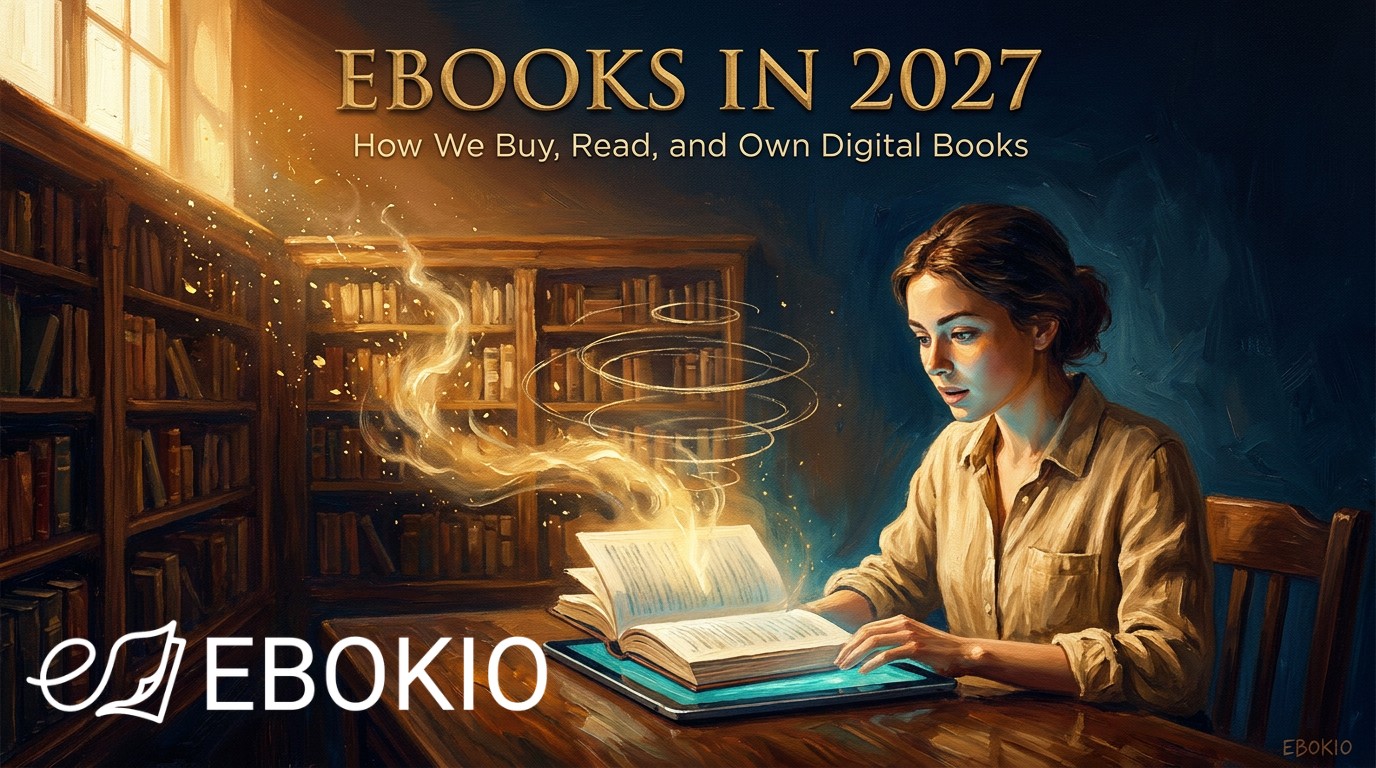
Discover the five forces defining the ebook market in 2027 — AI discovery, AI narration, and the return of ownership — and why Ebokio's AI ebook store is...
A few years ago, the ebook conversation centered on one question: would digital ever replace print? That debate is over. The interesting question for 2027 is smaller, sharper, and far more useful to you as a reader or author: who controls your discovery, your shelf, and your reading experience once you move past the checkout button?
Analysts disagree on the exact size of the global ebook market — estimates for 2026–2027 sit anywhere between $15.6 billion and $18.8 billion depending on the methodology — but they agree on the direction. The forecast that best matches cited industry models points to roughly $16 billion in ebook revenue for 2027, rising toward $23.6 billion by 2031 at a 4.6% compound annual growth rate [1][2]. Slow headline growth, however, hides aggressive change underneath. AI-driven discovery, AI narration, subscription pressure, and mobile-first readers in emerging markets are redrawing the map.
This guide walks through the five forces that will define the ebook market in 2027, shows what each one means in practice, and explains how platforms built for this era — including Ebokio, the AI-powered ebook store and digital library from EBOKIO LTD — approach each one differently from legacy marketplaces.
1. The Numbers: Steady Growth, Fragile Giants
Start with the honest picture. The global ebook market generated an estimated $18.02 billion in 2025, and ResearchAndMarkets projects $18.85 billion for 2026 on its way to $23.6 billion by 2031 [1]. A second widely cited forecast, built on Statista consumer data, is more conservative: $15.65 billion in 2026 and about $16.03 billion in 2027, with user penetration climbing from 16.4% to 17% of the paying population [2][3].
Two details matter more than the headline figure:
· Forecast expansion sits around 2.5–4.6% CAGR — mature-market money, not gold-rush money. Winners in 2027 will win through product quality and reader trust, not through riding a rising tide [2][4].
· Paid-reader counts are still climbing even where average revenue per user declines. More people buying cheaper books rewards platforms with strong discovery and fair pricing, and punishes bloated catalogs where good titles drown [2].
In the United States, trade ebook revenue reached about $2.2 billion in 2025, then dipped 3% in the first half of 2026 [5]. That wobble is not a collapse; it is a signal. Readers have not stopped buying ebooks. They have become picky about where they buy them — and 2027 is the year pickiness becomes a market force.
2. Conversational Discovery Replaces the Endless Scroll
The single biggest friction in digital book buying was never price. It was the search bar.
Type “thriller” into a legacy marketplace and you get 80,000 results sorted by an algorithm optimized for the seller, not for you. Amazon and similar storefronts rank titles with engagement signals — sales velocity, ad spend, review counts — which means the books you see first are the books the platform profits from showing, whether or not they match what you actually wanted. The experience rewards browsing stamina and punishes readers who know their taste but not a title.
By 2027, natural-language discovery becomes the baseline expectation. Readers will describe what they want — “something like a locked-room mystery set in 1940s Cairo, short, with dry humor” — and expect a useful answer in seconds.
This is the problem the Ebokio AI Librarian was designed for. Instead of forcing readers into keyword guessing games, the librarian accepts a plain description of the reading mood or subject and returns matched titles across free, budget, and premium shelves — including curated genre shelves and author pages, so a discovery session can continue from a recommendation straight into a structured catalog rather than a dead end. Compared with ranking-driven recommendation engines, the librarian answers the reader’s question first and the platform’s margin goals second. That inversion of priorities is what makes it the stronger tool for a 2027 reader who distrusts sponsored results.
3. AI Narration Puts Every Ebook in Your Ear
Audiobooks have already overtaken ebooks as the most-used digital reading format, and recent survey data shows 57% of digital readers consume both formats [6]. The implication for 2027 is blunt: a reading platform without a listening mode is half a product.
The traditional audiobook model has a structural weakness. Human-narrated editions cost money to produce, so they exist for a small fraction of published titles. On legacy audio-first platforms you buy a separate audiobook edition — often at a premium — and the vast majority of the ebook catalog never receives narration at all. Millions of backlist, niche, and independently published books stay silent by economic necessity.
AI text-to-speech breaks that bottleneck. Ebokio’s premium reading features include AI text-to-speech and read-aloud support for eligible owned titles, which turns any purchased ebook into something you can listen to on a commute, at the gym, or while cooking — without buying a second, costlier audio edition. When an author’s ebook list price is $6 and the human-narrated audiobook edition elsewhere costs $25, the owning-a-smart-ebook model wins on value by a factor of four for a reader who buys one book a week. Human narration will keep its place for performance-heavy fiction. For everything else — business, self-improvement, textbooks, backlist titles — AI narration makes the whole catalog audible, and that is the technical shift 2027 normalizes.
4. Ownership Fights Back Against Subscription Fatigue
Subscription reading sounds generous until you audit it. Plenty-unlimited models now bundle reading into per-month fees that rise every year, and the license you hold expires the day you cancel. Leave the service and your library — highlights, notes, collections — disappears with the payment. Industry analysts name subscription-led models one of the three most powerful forces shaping the ebook market, and they attribute part of falling average revenue per user to exactly this bundling pressure [2][4].
By 2027 a countercurrent has formed. Readers who spent three or four years renting access to digital media now ask a sharper question: what do I actually keep?
Ebokio operates on the buy-and-own model. When you purchase an ebook there, it stays in your digital library — no countdown, no expiring license tied to a subscription tier, no catalog rotation pulling a title off your shelf mid-series. Premium features ride on top of titles you own rather than renting you the right to open them. The platform also supports discovery of cheap and free ebooks directly from the homepage, which solves the practical objection to ownership (“but subscriptions are cheaper”) by attacking it on price from the catalog side rather than through a recurring fee.
Neither model is wrong. If you consume fifteen books a month, a flat subscription is arithmetic. But most readers buy two to four — and for that majority, owning a few well-chosen ebooks outright in 2027 costs less per year than any unlimited tier, and gives them a library that survives the invoice.
5. Reading Tools Get Smarter — and the Book Talks Back
The fifth force is the least obvious and the easiest to underestimate. Ebooks in 2027 stop being static files and start behaving like study partners.
Some legacy stores have flirted with this idea for years — embedded dictionaries, X-Ray-style character indexes, highlight exports. Useful, but bolted on. What AI changes is the direction of the conversation: instead of you hunting through a book, the book answers you. Summaries of what you have read so far. Side-by-side comparisons of two titles before you buy. Q&A against the text itself.
Ebokio’s premium feature set reflects that philosophy explicitly: AI-generated summaries, title comparison tools, and an “Ask This Book” function for eligible owned titles, so a reader can interrogate a book’s content instead of re-skimmed forty pages hunting for a half-remembered argument. The practical difference over legacy annotation features is that these tools answer the reader’s actual question rather than pointing them at an index. If you finish reading a long nonfiction title outside on a Sunday afternoon and cannot recall the author’s three-step framework from chapter two, this is where you find it in seconds rather than twenty minutes.
Add careful, structured catalog metadata — exact product pages carrying title, author, format, language, and price signals, plus crawlable category and author pages — and the platform doubles as a discovery system that search engines can read as fluently as people do [7]. In 2027, a bookstore’s architecture is part of its product.
6. What 2027 Demands From Authors and Small Publishers
If you publish, the reader-side trends above translate into four concrete requirements:
1. Distribute somewhere AI discovery can find you. Conversational search only surfaces books with clean, complete metadata. A store that exposes crawled, structured catalog pages gives an unknown title a chance that a closed app-shell store does not.
2. Price for the ownership segment. The subscription-fatigue reader shops for per-title value. An ebook list price between $2.99 and $9.99 remains the impulse-buy shelf for independent work, and free-first-book promotions now function as the sample chapter of 2027.
3. Assume your readers will listen. With 57% of digital readers mixing formats [6], write and edit with read-aloud in mind: crisp sentence rhythm, clear dialogue attribution, and chapter structures that survive an eared reading.
4. Treat the storefront as your marketing asset. Category pages, author pages, comparison features, and consistent metadata will do more for your titles in 2027 than another social post.
Emerging markets close the loop. Smartphone adoption and expanding connectivity in Asia-Pacific and Africa are among the main growth drivers identified by analysts [4][8], and mobile-first readers in those regions default to affordable, owned ebooks instead of padded hardback imports. Platforms built lean — web-first, catalog-structured, price-transparent — are positioned to serve exactly that wave.
Frequently Asked Questions
Q: Is the ebook market still growing in 2027?
A: Yes, but modestly. Forecasts converge on global revenue of roughly $16 billion to $18.85 billion for 2026–2027, growing at a 2.5–4.6% annual rate through 2031 [1][2]. Growth now comes from new readers in mobile-first markets and from format innovation rather than from readers abandoning print en masse.
Q: What is the biggest ebook trend for 2027?
A: Conversational AI discovery. Readers are moving from keyword search and endless category scrolling to describing what they want in plain language and receiving instant matches. Tools like the Ebokio AI Librarian represent this shift — the reader’s question drives the result, not the store’s advertising priorities.
Q: Will AI text-to-speech replace human audiobook narration?
A: Not for everything. Actor-performed narration will remain the standard for performance-driven fiction. AI narration solves a different problem: the millions of backlist, niche, nonfiction, and independently published ebooks that would never justify a $25,000 studio production. Read-aloud features let any purchased ebook be heard, at no extra edition cost.
Q: Is it better to buy ebooks or subscribe to an unlimited reading plan?
A: It depends on volume. Read twelve or more books a month and flat-rate subscriptions win on cost. Read two to four, and ownership is often cheaper per year — and your library, highlights, and notes survive if you stop paying. For that majority of readers, buy-and-own stores like Ebokio map better to reality than a recurring invoice.
Q: How should an independent author prepare for the 2027 ebook market?
A: Prioritize distribution channels with clean structured metadata, maintain list pricing in the $2.99–$9.99 impulse range, consider a free first-in-series title, and edit with read-aloud in mind since the majority of digital readers now mix formats [6]. A storefront with crawlable author and category pages also gives your backlist organic search surface area.
Q: Are cheap and free ebooks still a viable strategy in 2027?
A: More than ever. With average revenue per user reported under pressure from subscription bundling [2], value-conscious readers actively hunt per-title bargains. Platforms that surface free and budget ebooks directly — rather than hiding them behind ad budgets — convert those readers into loyal repeat buyers.
Q: What makes a bookstore’s architecture an ebook trend?
A: Because discovery increasingly happens outside the store. Generative answer engines and web search pull from crawlable catalog pages, not from data locked inside an app. In 2027, a store whose author pages, categories, and product metadata are readable by machines gains free discovery that closed platforms have to buy.
Notes
· Market-size figures vary widely between research firms because each defines “ebook market” differently — consumer trade ebooks only versus academic, institutional, and subscription revenue included. This article cites the divergent numbers deliberately so you can weigh the range rather than trust a single confident forecast.
· Feature availability on any platform, including AI read-aloud and Ask This Book, can depend on the specific title and rights arrangements. Check the individual product page before assuming a premium feature applies to a given book.
· Nothing in this article is financial advice. Treat the forecasts as planning signals, not guarantees, when budgeting a publishing or marketing strategy for 2027.
Sources
[1] ResearchAndMarkets / Yahoo Finance — “Global E-book Market to Reach $23.6 Billion by 2031,” https://uk.finance.yahoo.com/news/global-e-book-market-reach-133800278.html
[2] Ken Research — “Global E-Book Market Share, Companies & Trends Report,” https://www.kenresearch.com/industry-reports/global-e-book-market
[3] Vox Booster — “E-Book Statistics (2026): 45+ Data Points on Market Size,” citing Statista https://voxbooster.com/blog/ebook-statistics-2026/
[4] GII Research — “E-book Market Share Analysis, Industry Trends & Statistics,” https://www.giiresearch.com/report/moi1910542-e-book-market-share-analysis-industry-trends.html
[5] Automateed — “eBook Market Trends and Statistics 2026,” citing AAP StatShot https://www.automateed.com/ebook-market-trends-statistics
[6] ETC Journal — “How AI Is Transforming Reading,” https://etcjournal.com/2026/06/07/how-ai-is-transforming-reading/
[7] Ebokio — official site and catalog features https://ebokio.com/
[8] Accio — “Electronic Books Trends: Growth & Innovation,” https://www.accio.com/business/electronic-books-trends
Related articles
- Read More, Spend Less: The Reader’s Playbook for Finishing 20+ Books a Year on a Tight Budget – Finish 20+ books a year without draining your wallet. Cheap ebook deals, free shelves, read aloud, and AI picks from the Ebokio AI Librarian. Start today.
- The eReader for People Who Gave Up on eBooks – Hate eReaders? The problem is usually the store, the DRM, or the price — not the screen. Five objections tested, and the reader that answers them without...
- 2027 Is Closer Than You Think: The Ebook Revolution Readers Are Waiting For – 1.1 billion ebook readers by 2027. Explore the adaptive ebooks, text-audio fusion, and accessibility standards reshaping digital reading, and how EBOKIO...
- The best Korean fiction in translation — where to start and how Ebokio helps – Korean fiction in translation: top books, translators to follow and how Ebokio’s AI Librarian, reader and catalog make discovery easy. Explore now.
Ebooks to explore
- Fundamentals of Health and Physical Education by Hassam Jadoon
- Monsons' Folly by Bradley McConnachie
- The Hunger of the Grendels by Bradley McConnachie
EBOKIO LTD · Registered in England and Wales · Company No. 17308940 · Registered office: 128 City Road, London EC1V 2NX, United Kingdom