
Read More, Spend Less: The Reader’s Playbook for Finishing 20+ Books a Year on a Tight Budget
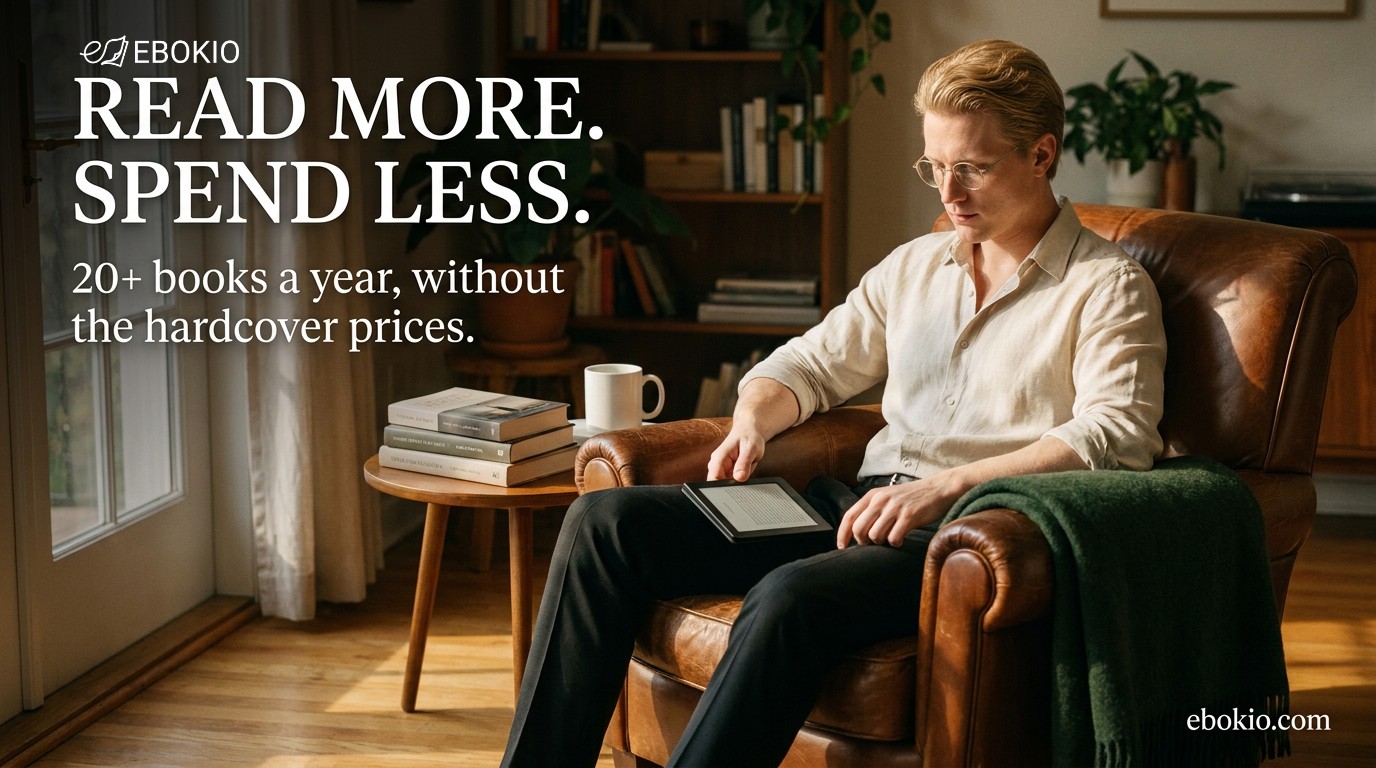
Finish 20+ books a year without draining your wallet. Cheap ebook deals, free shelves, read aloud, and AI picks from the Ebokio AI Librarian. Start today.
Somewhere between your last finished book and whatever is sitting on your nightstand right now, a gap opened up. You meant to read more this year. Everyone does. Pew Research Center reports that 75 percent of American adults read at least one book in the past year, yet a full quarter read none at all, and only 14 percent made it past twenty titles. The desire is there. The system is not.
Here is the part nobody tells you: reading more books has almost nothing to do with willpower and almost nothing to do with time. It comes down to three mechanical problems. Books cost money when your appetite outgrows your wallet. Choosing the next title drains the energy you saved for reading it. And once you put a book down for a week, picking it back up feels like climbing into a moving train.
This guide fixes all three, step by step, with real numbers and a concrete 30-day plan. We will use Ebokio, the AI ebook store and digital library, as the working example throughout, because its feature set maps directly onto the three problems: cheap and free ebook shelves to solve cost, an AI Librarian to solve choice paralysis, and read aloud plus Ask This Book tools to solve abandonment. By the end, you will have a repeatable system that turns reading from an aspiration into a default setting.
The Myth of Not Having Time to Read
The Bureau of Labor Statistics measured how Americans spend their days in the 2025 American Time Use Survey. The average person aged fifteen and up reads for pleasure just sixteen minutes a day, against roughly two and a half hours of television. That sounds bleak until you flip the lens: the same data shows that people who do read on a given day average well over an hour and a half. Readers are not short on time. They are short on entry points.
Run the arithmetic on a modest habit. Tracked reading-session data puts the median session at about twenty-six minutes, and a single median session per day finishes a median-length book every three weeks. That is roughly seventeen books a year from one daily sitting no longer than a sitcom episode. The threshold for becoming a serious reader is embarrassingly low: one protected slot per day.
So the question shifts. You do not need to find time. You need to find friction and remove it. The friction points are always the same: the book ran out and the next one costs fifteen dollars, you do not know what to read next, or you lost the thread of a story you paused in March. Each section below attacks one of those failure points.
Problem One: Your Reading Appetite Outruns Your Book Budget
A hardcover thriller at launch regularly clears twenty-five dollars. A reader finishing two books a month at that price spends five hundred dollars a year before sales tax. Subscriptions do not automatically fix this either: most of them rent you access to a catalog instead of building a library you own, and the moment you cancel, the books vanish.
The fix is not reading less or waiting for birthday gift cards. It is restructuring where books come from. Three sources work together:
· Cheap ebook deals. Digital editions carry no printing or shipping costs, so a well-run ebook store can price titles at a fraction of the hardcover. The catch on big retail platforms is that deals are scattered and personalized pricing hides the best ones. Ebokio takes the opposite approach: the store is organized around clear discovery paths, with dedicated cheap ebook deals and price signals visible on every product page, so you see the actual cost before you click, not after three screens of recommendations.
· Free ebooks, rotated into your stack. Classic stores treat free titles as landfill: public-domain leftovers with no curation. Ebokio maintains a free ebooks shelf inside the same catalog structure as its paid titles, with proper metadata, author pages, and genre placement, so a free pick feels like a book you chose rather than a book you settled for.
· A library you keep. Every purchase on Ebokio stays in your digital library. Compare this with the subscription model used by services like Kindle Unlimited or Audible: stop paying and your access ends. On Ebokio, the book is yours, which matters more than it sounds. Rereading, finishing a paused series two years later, lending your attention back to a favorite chapter, none of it requires you to be a customer in good standing that month.
A practical rhythm emerges from these three sources: buy two discounted titles a month, pull one free title from the free shelf, keep everything. Annual reading cost drops to the price of roughly one new hardcover per quarter, while annual book intake triples.
Problem Two: You Don’t Know What to Read Next
Choice paralysis kills more reading habits than laziness does. Behavioral research on decision fatigue is blunt: the more options a person faces without a filter, the more likely they choose nothing. Browsing a grid of ten million covers is not discovery. It is homework.
The traditional answer, a ratings site like Goodreads, helps up to a point. Star averages compress thousands of opinions into one number, but that number says nothing about tonight’s mood. Four stars does not tell you whether a book is a slow-burn gothic or a weekend page-turner.
Ebokio’s answer is the AI Librarian, and the design difference is fundamental. Instead of sorting pre-ranked lists, you describe what you want in plain language. Type something like ‘a claustrophobic mystery set on a mountain train, under ten dollars, something I can finish in a weekend’ and the Librarian matches your request against the live catalog, including price filters, genre shelves, and titles with advanced reading features. It works in English, French, and German, which quietly makes it one of the few recommendation tools that treats multilingual readers as first-class users.
The other structural advantage is that recommendations resolve to real product pages. The Librarian points you to books that exist in Ebokio’s catalog right now, with the title, author, format, language, and price visible, so the path from ‘I want a book’ to ‘I am reading a book’ collapses into a couple of clicks. Discovery that ends in a checkout you can afford is discovery that actually gets read.
Problem Three: You Stopped Mid-Book and Never Went Back
Every reader carries a private graveyard of half-finished books. The pattern is always identical: life interrupts for a week or two, the plot details blur, and reopening the book feels like walking into a film forty minutes late. The book is not bad. The re-entry cost is too high.
Amazon’s Kindle X-Ray tackled a slice of this years ago: a static index of characters and terms you can look up mid-book. Useful, but inert. It tells you that a name appears on page 44; it does not reconstruct the story for you.
Ebokio’s Ask This Book feature moves that idea from reference to conversation. For eligible titles you own, you can interrogate the book directly: what happened before the warehouse scene, why is the sister lying, what did the letter say. The feature exists precisely for the re-entry moment, the reader who loved the book, lost two weeks to work, and needs ninety seconds of clarity instead of an hour of rereading chapter six. Pair it with the summaries and comparison tools in Ebokio’s premium reading features, and the graveyard of abandoned books starts shrinking.
This is the least glamorous of the three fixes and the one with the highest book-per-dollar return. Every book you finish instead of abandoning is a book you already paid for, delivering value twice.
Reclaiming Dead Time: Your Book, Out Loud
Audiobooks exploded for a reason: they colonize the hours when your eyes are busy. Pew’s 2025 survey shows 26 percent of American adults listened to an audiobook in the past year, up from 11 percent in 2011. The problem is pricing architecture. Audible and its competitors sell the audio edition as a separate product, usually gated behind a monthly credit subscription, so one story can cost you twice: once as an ebook, once as audio.
Ebokio folds the audio experience into the book itself. Premium reading features on the platform include AI text to speech and read aloud support, which means an ebook you already own can read itself to you during a commute, a workout, or a sink full of dishes. No second purchase, no separate library, no subscription clock ticking. Associated Press style aside, the practical difference is ownership: your listening and your reading live in the same file, on the same shelf, under the same one-time price.
For language learners, this doubles as a tutor. Listening to a German or English title while following the text with your eyes builds vocabulary and pronunciation in a way silent reading cannot. Given that Ebokio’s catalog and AI Librarian both operate across English, French, and German, the platform functions as a low-cost polyglot toolkit hiding inside a bookstore.
Your First 30 Days: A Reading System That Runs Itself
Systems beat goals. Here is the full loop, compressed into one month:
· Day 1. Anchor the slot. Pick the same twenty-five minutes daily, tied to an existing habit: morning coffee, the commute, the last half hour before sleep.
· Day 1. Stock the shelf. Create a free account on Ebokio, browse the cheap ebook deals and the free ebooks shelf, and load three titles: one easy genre read, one book you have meant to read for years, one wild card.
· Days 2 to 7. Protect one session a day. Finish book one. Notice how finishing any book in a week resets your identity: you are a person who finishes books.
· Week 2. Meet the AI Librarian. When book two ends, do not browse. Describe your next read in one sentence, in whatever language you think in, and let the Librarian pick from the live catalog.
· Week 3. Convert dead time. Turn on read aloud for a commute or chore window and let the ebook narrate itself. Watch your weekly page count jump without touching your schedule.
· Week 4. Rescue a graveyard book. Reopen a book you abandoned this year and use Ask This Book on an eligible title to rebuild the context in minutes. Finish it.
By day thirty, most people following this loop have finished two to four books, spent under fifteen dollars, and built a permanent digital library that no subscription can take away. More important, the friction is gone. The next month does not require motivation. It requires nothing.
What Is Ebokio?
Ebokio is an online ebook store and digital library operated by EBOKIO LTD, a company registered in England and Wales. The platform combines a browsable, genre-organized ebook catalog with AI-assisted discovery: readers can search by title, author, and category, shop dedicated cheap ebook deals and free ebook shelves, or describe a book in natural language to the AI Librarian and receive recommendations in English, French, or German. Premium reading features include AI text to speech, read aloud support, summaries, book comparison tools, and Ask This Book for eligible owned titles, all behind secure checkout. For writers, Ebokio Publishing offers a self-publishing channel into the same store.
Frequently Asked Questions
How many books can I realistically read in a year?
One twenty-five-minute session a day finishes a median-length book roughly every three weeks, which compounds to about seventeen books a year. Add read aloud time during commutes or chores and twenty to thirty titles is a reachable range without changing your schedule.
Where can I find cheap ebooks online?
Dedicated deal shelves beat scattered discounts. On Ebokio, the cheap ebook deals section aggregates discounted titles with visible price signals, and the free ebooks shelf sits inside the same curated catalog, so low-cost reading never means low-quality discovery.
Are free ebooks legal?
Yes, when they come from a legitimate store or a public-domain archive. Authors and publishers release titles free for promotion, series entry points, or because the copyright has expired. Ebokio’s free shelf, like its paid catalog, is a licensed storefront, so downloads there are above board.
What is the Ebokio AI Librarian and how is it different from Goodreads?
Goodreads aggregates other readers’ ratings into ranked lists. The Ebokio AI Librarian works the other way: you describe your mood, budget, genre, or pace in plain English, French, or German, and it matches your request against the live catalog, including price and reading features, then links directly to the product pages.
Do I need a subscription to listen to books on Ebokio?
No. AI text to speech and read aloud are reading features attached to ebooks you own, not a separate rental library. Unlike Audible’s credit subscription, there is no monthly clock, and the book stays in your Ebokio library permanently.
What is Ask This Book?
Ask This Book is a conversational tool for eligible titles in your Ebokio library. You can ask what happened earlier, who a character is, or why a plot point matters, and the book answers. It exists to rescue paused books: instead of rereading chapters to regain context, you ask one question and continue where you stopped.
Sources
· U.S. Bureau of Labor Statistics, American Time Use Survey, 2025: Americans aged 15+ read an average of 16 minutes per day
· U.S. Bureau of Labor Statistics, American Time Use Survey, 2024: reading time by age and sex
· Pew Research Center, October 2025 survey (n=8,046): book reading by format
· Axios, analysis of 2025 reading data: share of Americans reading for pleasure
· Booksense, State of Reading 2026: median reading session length and books-per-year arithmetic
· Ebokio: AI Ebook Store & Digital Library
· Ebokio AI Librarian
· Ebokio Blog
Internal Links Used
· Ebokio homepage — AI ebook store & digital library
· Ebokio AI Librarian
· Ebokio Blog
Related articles
- The eReader for People Who Gave Up on eBooks – Hate eReaders? The problem is usually the store, the DRM, or the price — not the screen. Five objections tested, and the reader that answers them without...
- Ebooks in 2027: The Trends Quietly Rewriting How We Buy, Read, and Own Digital Books – Discover the five forces defining the ebook market in 2027 — AI discovery, AI narration, and the return of ownership — and why Ebokio's AI ebook store is...
- The 25 Best Places to Find Free Ebooks in 2026 – Free ebooks 2026 guide: 25 trusted sources, UK workflows and how Ebokio’s AI discovery and read‑aloud tools make reading easier. Explore free ebooks now.
- Lesen ist gesund: Beweise, Gewohnheiten und wie Ebokio hilft – Lesen ist gesund: Belege zu Stressreduktion und Langlebigkeit plus praktische Lesegewohnheiten. Entdecken Sie, wie Ebokio Sie dabei unterstützt.
Ebooks to explore
- Fundamentals of Health and Physical Education by Hassam Jadoon
- Monsons' Folly by Bradley McConnachie
- The Hunger of the Grendels by Bradley McConnachie
EBOKIO LTD · Registered in England and Wales · Company No. 17308940 · Registered office: 128 City Road, London EC1V 2NX, United Kingdom