
2027 Is Closer Than You Think: The Ebook Revolution Readers Are Waiting For
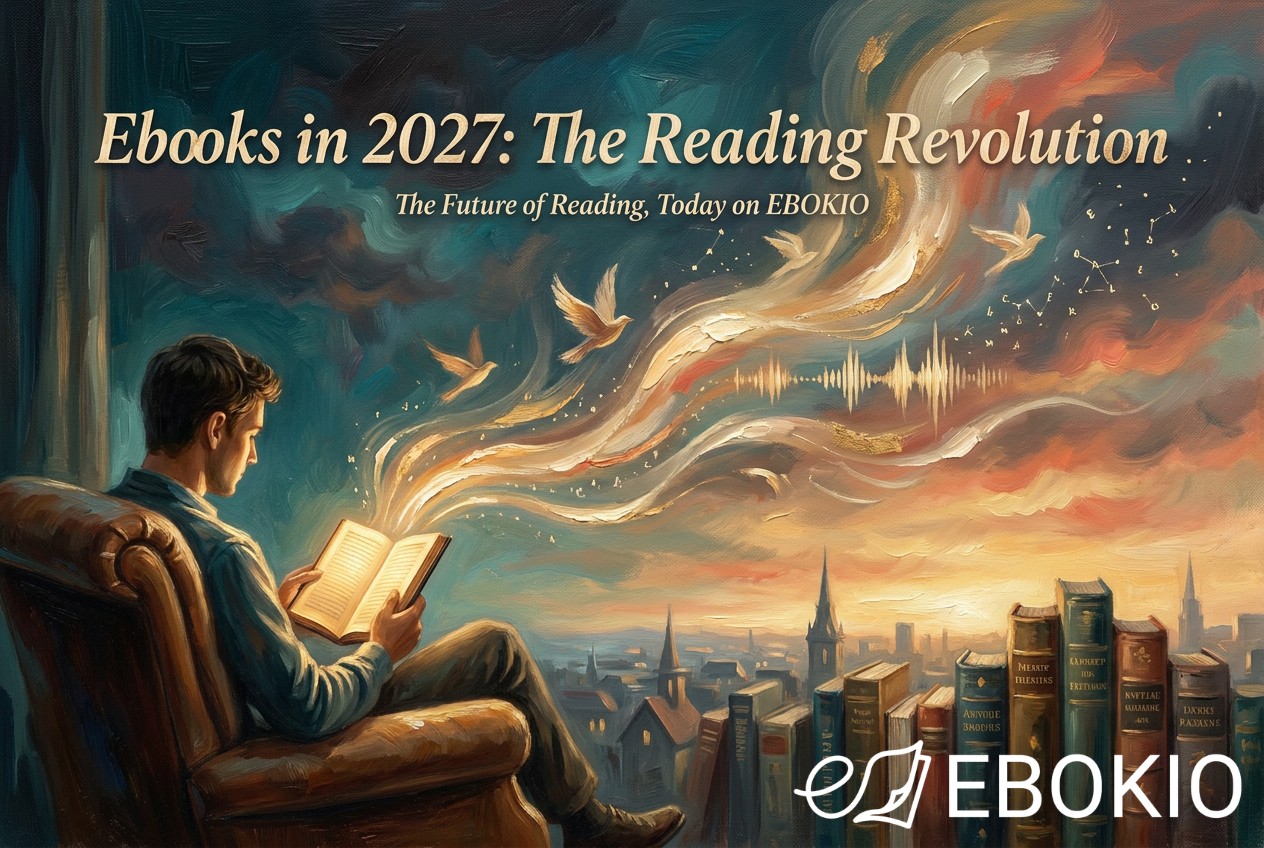
1.1 billion ebook readers by 2027. Explore the adaptive ebooks, text-audio fusion, and accessibility standards reshaping digital reading, and how EBOKIO...
Something quiet is happening inside your library. While most readers still think of ebooks as flat digital copies of printed pages, engineers, publishers, and accessibility experts are rebuilding the format from the inside out. By 2027, the ebook you open on your phone will behave nothing like the one you downloaded five years ago. It will adjust to your reading level, shift between text and narration without losing your place, answer your questions about its own chapters, and meet strict accessibility standards that were optional only a few years earlier.
This is not speculation dressed up as prophecy. Market analysts, web standards bodies, and publishing houses have all left a trail of evidence pointing at the same window of time. Industry projections place the global ebook audience at roughly 1.1 billion readers by 2027, and the technical standards that will govern those reading experiences are already published and enforceable. What remains undecided is which platforms will deliver that future first. At EBOKIO, we have spent our development roadmap answering that question, and this article explains what is coming, why it matters, and how we are building for it.
The Billion-Reader Milestone That Changes Everything
Every publishing era has a tipping point, and the data points to 2027 as the next one. Statista-derived market projections estimate that the worldwide ebooks market will reach approximately 1.1 billion readers by 2027, with user penetration climbing from 13.3 percent in 2024 to 14.1 percent. The same projections put market volume near 15.33 billion US dollars, with average revenue per user around 14.18 dollars. Independent forecasts from other research firms land in the same territory: one 2026 industry report models the market at roughly 16 billion dollars in 2027, continuing toward 17.67 billion by 2031.
Raw numbers rarely tell the interesting part of a story. What matters is what a billion-person audience forces an industry to do. When ebooks served a niche of early adopters, publishers could treat digital editions as an afterthought: scan the print layout, export a file, move on. A billion readers includes people with visual impairments, commuters who switch between eyes and ears, students reading in a second language, and children who need vocabulary support. That diversity makes the old flat-file approach unsustainable. The format has to become flexible, and the platforms selling those files have to become smarter. Both shifts are already underway, and both converge on 2027.
Trend One: Ebooks That Adapt to the Reader
Research from Tata Consultancy Services describes generative-AI-powered ebooks as a dynamic evolution of the format: titles that adjust difficulty levels for younger readers, translate sentences in real time, and personalize the experience based on a reader’s focus and environment. A book that meets you where you are, rather than demanding you meet it where it was printed.
Consider what this means in practice. A reader in Casablanca picks up an English-language thriller. An adaptive ebook can simplify an unfamiliar idiom, offer a French or Arabic gloss, or switch to a slower narration pace during a crowded commute. None of this requires a different edition. The same file serves a teenager in Jakarta, a retiree in Lisbon, and a student in Riyadh, each receiving a version shaped to their needs.
Most major stores still sell you a static object and leave the adaptation work to you. EBOKIO approaches the problem from the platform level. Our premium reading features include AI-generated summaries that help you decide whether a book fits your current goal, comparison tools that place related titles side by side, and Ask This Book, an interactive feature that lets you question eligible titles you own about their own content. Instead of leaving a novel to search a forum for an explanation of a plot thread, you ask the book itself. That is the adaptive principle applied today, not promised for tomorrow.
Trend Two: The Wall Between Text and Audio Comes Down
Ask any reader who commutes: the frustration is not choosing between reading and listening, it is the artificial wall between them. The dominant industry model still treats an audiobook as a separate product with a separate price tag, sometimes costing more than the ebook itself. Buy both, and you own the same story twice.
The TCS research describes a different architecture: ebooks that transition seamlessly between text and audio, synchronize highlighting with narration, and layer background music that matches the scene’s mood. Text and voice become two views of one file rather than two products in two storefronts. By 2027, this synchronized model is expected to move from experimental feature to reader expectation.
This is where the comparison with incumbent platforms turns concrete. A leading audiobook service sells narration as a standalone purchase or locks it behind a monthly credit system. EBOKIO integrates read-aloud support and AI text-to-speech directly into the reading experience for eligible owned titles. You purchase the book once, and the platform lets you listen to it, read it, or alternate between the two. The story stays one purchase; only your posture changes. For a reader who reads at home and listens in the car, that difference compounds into real savings across a year of reading.
Trend Three: Accessibility Stops Being a Checkbox
The least glamorous trend on this list may be the most consequential. The European Accessibility Act entered into application on 28 June 2025, and ebooks sit explicitly inside its scope. The directive requires ebooks and their reading software to support text-to-speech, allow readers to adapt presentation such as font size, contrast, and line spacing, expose metadata so assistive technology can navigate the content, and prevent copy-protection measures from blocking accessibility features.
On the technical side, the W3C has published EPUB 3.3 as the stable format recommendation, accompanied by the EPUB Accessibility specification, which mandates metadata fields describing how a publication can be read: whether it supports screen readers, whether it offers synchronized audio and text, whether it contains hazards such as flashing content. The standard recommends conformance with WCAG level AA. Retailers, distributors, and reading systems operating in European markets must now demonstrate this conformance, and other jurisdictions are watching the European rollout closely.
Enforcement timelines take years to mature, which is why 2027 stands out: it is the point by which publishers, platforms, and reading systems will have had to complete their compliance cycles or exit regulated markets. For readers with disabilities, the shift is profound. A file with an .epub extension is not automatically an accessible ebook; accessibility lives in the semantic markup, the navigation document, and the metadata that platforms choose to surface. EBOKIO treats these requirements as product features rather than legal chores. Read-aloud support, adaptable presentation, and structured catalog metadata are built into how our store describes and delivers every title, so a screen-reader user receives the same discovery experience as everyone else.
Trend Four: You Stop Searching and Start Describing
Type a word into the search bar of the largest ebook retailer and you receive a ranked list shaped by sales velocity and advertising spend. The system answers a question you did not quite ask. Readers do not think in keywords; they think in moods, situations, and half-remembered plots. They want to say: something quiet and melancholic, set by the sea, under three hundred pages, that I can finish this weekend.
Natural-language discovery is the next competitive frontier in digital reading, and it is the problem the EBOKIO AI Librarian was built to solve. Instead of forcing readers to guess the right keyword, the AI Librarian accepts a description in plain language and guides the reader toward matching titles, genre shelves, deals, free ebooks, and premium picks. Behind it sits a fully crawlable catalog with structured metadata on every product page: title, author, format, language, and price, connected through category and author pages so both humans and search engines can navigate real relationships between books. Where a keyword search returns what is popular, a librarian returns what fits.
Trend Five: Authors Reach the Billion-Reader Market Directly
A billion-reader market rewrites the economics of authorship. Traditional gatekeeping made sense when distribution was scarce; shelf space was finite, and someone had to choose. Digital shelves have no such constraint, yet the largest self-publishing channels still impose their own frictions: royalty tiers that penalize certain price points, exclusivity programs that forbid selling elsewhere, and discovery algorithms that bury new names beneath established brands.
The counter-model is the open marketplace, and it is the model behind publishing.ebokio.com , the publishing portal operated alongside our reader store. Authors and publishers upload their titles, manage their catalog, and sell directly to a global readership without exclusivity demands. The author keeps control of pricing and availability; EBOKIO provides the storefront, the secure checkout, the AI-assisted discovery, and the structured metadata that makes a new release findable from day one. As adaptive features, read-aloud tools, and accessibility standards raise the value of well-prepared digital files, authors who publish through a platform built around those standards start with an advantage that retrofitted catalogs cannot easily copy.
What EBOKIO Is Building Toward 2027
EBOKIO LTD is a digital publishing and ebook marketplace company registered in England and Wales, operating two connected portals: ebokio.com , the reader-facing store, and publishing.ebokio.com , the author and publisher portal. Our working premise is simple: the trends described above are not separate upgrades to be bolted on later. They are one product decision made repeatedly: treat the ebook as a living format and the reader as the person in charge of it.
Concretely, that means the store already combines features that competitors scatter across separate apps and subscriptions: AI-assisted discovery through the AI Librarian, read-aloud and AI text-to-speech for eligible owned titles, AI summaries and comparison tools, the Ask This Book interactive feature, curated categories and author pages, deals and free ebook shelves, and a secure checkout. It also means treating accessibility metadata and presentation flexibility as defaults, in step with the EPUB 3.3 and European Accessibility Act requirements that will define compliant publishing by 2027. The billion-reader market will reward platforms that made these choices early, and that is the bet our roadmap makes.
How to Prepare Your Reading Life for 2027
You do not need to wait for the future to arrive before benefiting from it. A few practical moves position you well:
•Choose platforms that sell reflowable, standards-based ebooks rather than locked proprietary files, so your library survives device changes.
•Prefer stores that include read-aloud support in the purchase instead of charging separately for narration.
•Use AI-assisted discovery tools to break out of bestseller loops; describe the book you want instead of guessing its keywords.
•If you read with assistive technology, check whether a store surfaces EPUB accessibility metadata before you buy.
•If you write, publish where accessibility and discoverability are defaults, because the 2027 reader will expect both.
None of these steps requires technical knowledge. They require buying from a platform that made the right architectural choices on your behalf.
Frequently Asked Questions
How many people will read ebooks by 2027?
Industry projections based on Statista data estimate the global ebook audience at roughly 1.1 billion readers by 2027, with user penetration reaching about 14.1 percent worldwide. Forecasts differ slightly between research firms, but they agree on steady growth driven by smartphone adoption, improved connectivity, and subscription reading models.
What is an adaptive ebook?
An adaptive ebook uses artificial intelligence to adjust itself to the reader: simplifying language, offering real-time translation, synchronizing text with narration, or answering questions about its own content. EBOKIO applies this principle through features such as AI summaries and Ask This Book, which lets you question eligible owned titles directly.
Will AI replace traditional reading?
No. The consensus across publishing research is that AI changes how readers find, experience, and apply books rather than replacing deep reading. Summaries and recommendations help you choose the right book; the immersive hours inside it remain yours. AI handles the friction, not the pleasure.
What makes an ebook accessible?
Under the EPUB 3.3 standard and the European Accessibility Act, an accessible ebook supports text-to-speech, lets readers change font size, contrast, and spacing, includes semantic markup and navigation for screen readers, and carries accessibility metadata describing its features. A file ending in .epub is not automatically accessible; the markup and metadata make it so.
Is EBOKIO free to use?
Browsing the EBOKIO catalog, using the AI Librarian, and reading the blog are free. The store sells individual ebooks at affordable prices and maintains dedicated shelves for free ebooks and deals. Premium reading features such as AI text-to-speech and Ask This Book apply to eligible titles you own.
How can authors publish on EBOKIO?
Authors and publishers register at publishing.ebokio.com , upload their titles, set pricing, and manage their catalog through the publishing portal. Titles then appear on ebokio.com with structured metadata, author pages, and access to the platform’s AI-assisted discovery features, without exclusivity requirements.
Will ebooks replace print books by 2027?
No credible forecast predicts that. Print continues to hold a large share of the market, and many readers use both formats for different situations. What 2027 will bring is a sharper divide between basic ebook files and the new generation of adaptive, accessible, audio-synchronized editions.
Notes
•All market figures cited in this article are third-party projections, not guarantees; research firms use different methodologies, which is why we present ranges rather than single numbers.
•European Accessibility Act obligations took effect on 28 June 2025; references to 2027 describe the practical window by which compliance cycles across the supply chain are expected to mature, not a legal deadline.
•EBOKIO premium features such as Ask This Book, AI text-to-speech, and summaries apply to eligible owned titles; availability may vary per book.
•Product comparisons in this article describe publicly known, general characteristics of competing platform categories as of September 2026 and are not statements about specific pricing, which changes frequently.
•This article is independent editorial content; no publisher or retailer influenced its conclusions.
Sources
1.Tata Consultancy Services — GenAI-powered eBooks can change reading as we know it — https://www.tcs.com/what-we-do/industries/high-tech/white-paper/generative-ai-powered-ebooks-revolutionize-reading
2.PDF Reader Pro — Top 90+ Ebook Sales Statistics & Trends (Statista-derived market projections) — https://www.pdfreaderpro.com/blog/ebook-statistics
3.Ken Research — Global E-Book Market Share, Companies & Trends Report 2026-2031 — https://www.kenresearch.com/industry-reports/global-e-book-market
4.W3C — EPUB 3.3 Specification — https://w3c.github.io/epub-specs/epub33/core/
5.W3C — EPUB Accessibility 1.2 — https://www.w3.org/TR/epub-a11y-12/
6.W3C — EPUB Accessibility: EU Accessibility Act Mapping — https://www.w3.org/TR/epub-a11y-eaa-mapping/
7.Disability World — EPUB3 for Accessible Publishing: What to Ship — https://www.disabilityworld.org/articles/epub3-for-accessible-publishing/
8.JD Meier — How AI Is Transforming the Future of Books — https://jdmeier.com/future-of-books-ai/
9.EBOKIO — AI Ebook Store & Digital Library — https://ebokio.com/
10.EBOKIO Publishing Portal — https://publishing.ebokio.com/
Related articles
- Ebooks in 2027: The Trends Quietly Rewriting How We Buy, Read, and Own Digital Books – Discover the five forces defining the ebook market in 2027 — AI discovery, AI narration, and the return of ownership — and why Ebokio's AI ebook store is...
- The eReader for People Who Gave Up on eBooks – Hate eReaders? The problem is usually the store, the DRM, or the price — not the screen. Five objections tested, and the reader that answers them without...
- Die besten Liebesromane, empfohlen im Jahr 2026 – Die besten Liebesromane 2026: Kuratierte Empfehlungen, Trends und wie Sie Titel auf Ebokio finden. Jetzt entdecken und Leseproben, TTS und Deals prüfen.
- Wie Sie jederzeit und auf jedem Gerät Bücher lesen können – Auf jedem Gerät Bücher lesen: Entdecken Sie den Ebokio Web‑Reader, TTS und Sync‑Features für sofortigen Zugriff. Jetzt testen und Bücher überall genießen.
Ebooks to explore
- Fundamentals of Health and Physical Education by Hassam Jadoon
- Monsons' Folly by Bradley McConnachie
- The Hunger of the Grendels by Bradley McConnachie
EBOKIO LTD · Registered in England and Wales · Company No. 17308940 · Registered office: 128 City Road, London EC1V 2NX, United Kingdom